Nerd Notes: February (barely)
Hey hey Nerds!
Let me kick off this month with a little note of gratitude...over the course of the last month, I've had the distinct pleasure of seeing quite a few of you in person and exchanging some pretty wonderful messages with several more of you, and it reminded me of this Henrik Karlsson post that was in the back of my mind when I launched Nerd Notes. The number of interesting ideas & projects, articles, podcasts, etc. that come out of this little group has been a source of incredible creative energy for me, and I couldn't be more delighted about it.
BTW, I meant to get this out to you yesterday, but due to dragging my feet a bit, let me say: Happy Pokemon Day!
Some Easter Eggs!
I was planning to have an Easter egg to share with you all this month, but actually I have two - thanks to a bit of midnight oil burning:
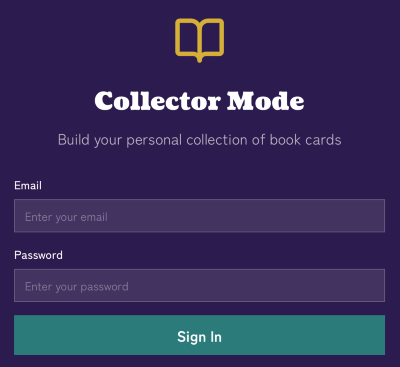
Read Me Like A Book "Collector Mode" is live! You all are the first to know about it. Here's the gist of it: every week you open a pack of 5 RMLAB cards & choose 1. You take/upload a photo of a book that fits the card, and you can choose to write a short explanation of why you chose that book. You can also choose whether you want to anonymously share your card into a chronological feed. It'll show up there 24 hours later. At the end of the week, the feed resets, and you can open a new pack of cards. If you see someone share something interesting on the feed, you can friend request them, and then they show up in a separate de-anonymized feed (this is a feature that I'm not sure I'm sold on). It's kind of a social network, but really it's a way to discover books & maybe feel a sense of shared humanity? It's not an engagement maximization machine or an incubator for deep-seeded insecurity! Let me know what you think!
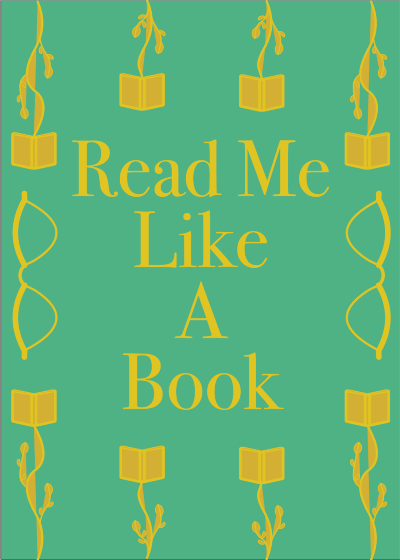
What I'm most excited about, though, comes from some feedback I've received from several of you as well as readers of the main newsletter: I spent some of the winter holiday designing a physical Read Me Like A Book deck and putting some thought into a non-bookstore-based version of the game that you could just play with friends...and I'm going to get a prototype printed. Because these things come with volume discounts, if any of you want a Read Me Like A Book card deck, just respond to this email with your address and once I have them I'll send one along to you along with instructions about 2 different game versions of the game.
Want a copy of the RMLAB physical card deck?
A little nostalgia with a hint of optimism
When I was in my teens, my father signed up for a subscription service that sent us a CD-ROM full of freeware and shareware every month. I loved the ritual of popping the CD-ROM into our iMac and opening up each program to see what it did, and copying anything that seemed interesting onto our hard drive. Some of my favorite games when I was an adolescent were puzzlers that came on one of those discs (aaaaand which I just rediscovered in the App store and started playing again, and it's every bit as good as I remembered even though I gave up games for Lent. I suspect that game might have hardwired my young brain and some long dormant neurons just lit up for the first time in years).
Do you remember freeware & shareware? People would write software, and they would either let you just have it for free (usually with the option to send the creator some money, but this was in the nascent days of online payments), or let you use it for as long as you want before deciding if you wanted to pay for it - and even then with payment based on the honor system, and you could copy it onto your computer's hard drive and pass the disk on to other people. Why would they do that? I suspect that there weren't many shareware millionaires - though maybe some people who parlayed shareware into more lucrative opportunities - so it mostly was about showing off and feeding an ecosystem of goodwill.
Freeware never died off - the spirit of it is still alive in a place like Github - but as software moved off the hard drive or local host and into the cloud, freeware kind of morphed into freemium models...which, for so many reasons, are just a lot less cool.
I think maybe, just maybe, we're headed into a new age of freeware, and I'm very much here for it. If you're reading this, you probably already have some ideas of why this could happen, but just in case you don't know, I want to start with the Cambrian Explosion.
The Cambrian Explosion!

Without going too deep into the biology of it all, about 500 million years ago life on Earth evolved beyond simple organisms of that step change in the complexity of living things, an unfathomable amount of new species emerged because increased complexity meant increased diversification.
All of that is to say, I think it's possible that what we're seeing with artificially intelligent coding agents is a stage in the Cambrian explosion of software (arguable whether it's the first stage. I am inclined to say that the internet was the actual beginning of this). Software hasn't been entirely monolithic, and it has certainly increased in diversity over time, but this feels to me like a moment where we're going to see an unprecedented growth in the diversity of software and in a way that's going to change our relationship with software.
I've been thinking a lot about a different Cambrian-style explosion that's more recent and more similar to what we're seeing with software, because I find both the similarities and the contrasts in it instructive: the Cambrian explosion of filmed media.
You know the trope: when I was a kid, there were only 4 channels of TV and the local cinema only had 2 screens. In reality, it was a bit more than that - there was cable (not that my parents would pay for it, but it existed), and our local multiplex was like a dozen screens. Still, filmed entertainment at that time was television shows and movies, and those were made by a very small number of people within a formal studio structure. Camcorders were a thing, but they were almost exclusively for personal use and of inferior quality to production-grade entertainment. Filmed entertainment was monoculture. If we just did a quick back of the envelope calculation and said that there were 100 television channels including cable and every one of those channels was airing original, never before scene content for 24 hours a day, then television was producing 2400 hours of new content every day. Movies were more production intense, so lower volumes of production...so let's say that we got an equivalent amount of new film every year to a day of television, roughly 500 new movies. Honestly, for where I'm going the number doesn't really matter - it could be 5,000 new movies.
Because a cursory Googling tells me that as of 2022 people upload 500 hours of video to YouTube every minute. Whatever generous number we want to assign to the production of filmed content per day in, say 1996, YouTube's daily upload eclipses it by almost 3 orders of magnitude. Sticking with 1996, at that time filmed entertainment had 4 forms: feature length movie, hourlong television show, half hour long television show, 5 minute music video.
All of that to say, in the course of 30 years we went from a world where there were 4 broadcast television channels, a few dozen movie studios, and a hundred or so cable television channels who were collectively producing somewhere on the order of 100,000 hours of new filmed entertainment every year within 4 categories:
- All of the above still exists (the number of movie studios might have changed, some consolidation, some new entrants, etc.)
- In addition, we have the content-producing streaming platforms that aren't bound by the constraint of channels x hours per day to determine how much new content they produce every year
- In addition, we have the content-hosting streaming platforms whose primary incentives all involve maximizing the amount of user-generated content available.
- In addition, we have video games that also include a lot of cinematic-quality film-like entertainment.
- As a result, we have every shape of category imaginable: 30 second reels, 10 minute videos, sequences of thirty 8 minute videos, 12 hour livestreams, and on and on ad infinitum.
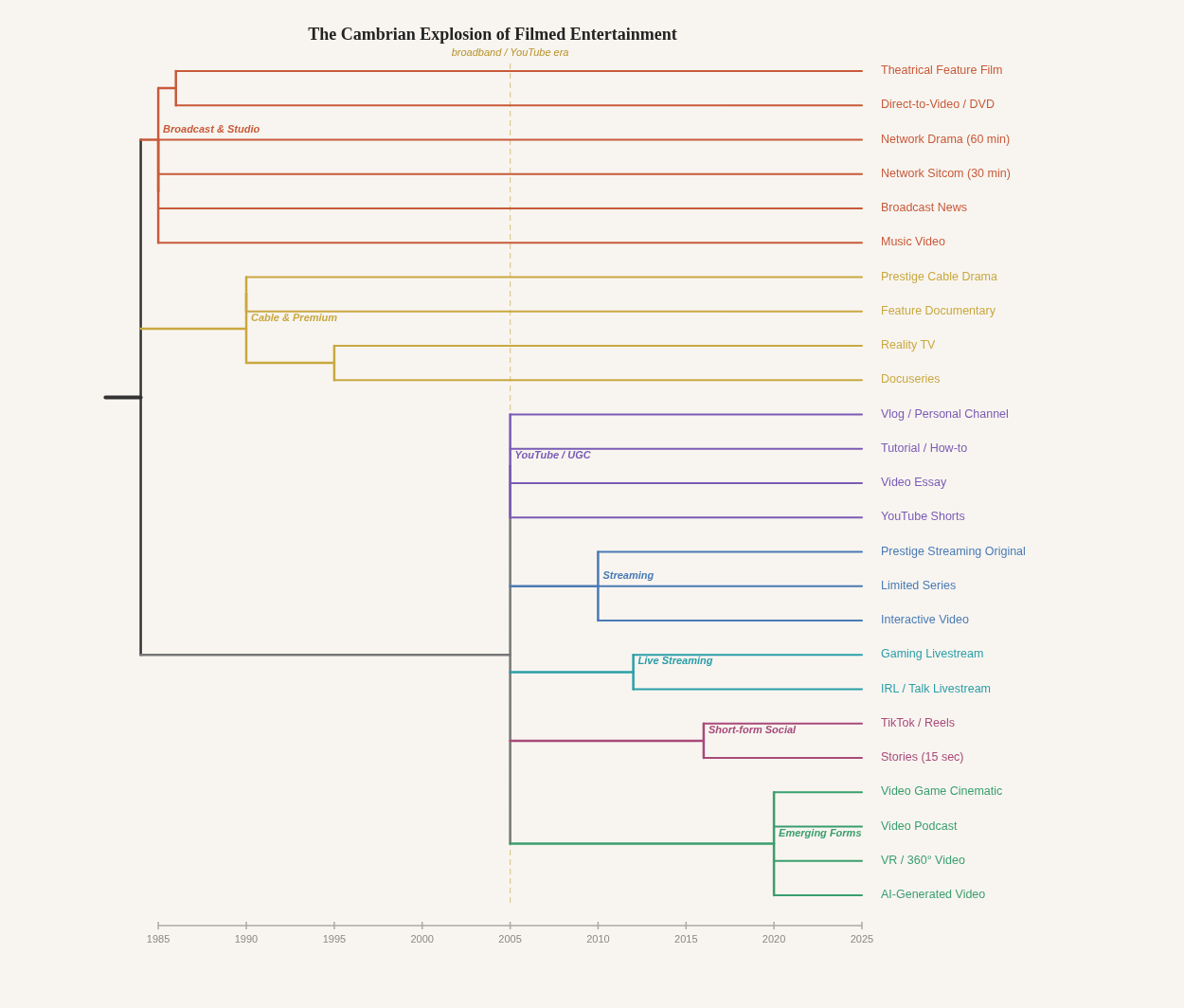
Filmed entertainment has diversified, and while "big events" feel even more monocultural than they were 30 years ago, that's in large part because there are fewer of them because our choices are so widespread that it takes that much more momentum for something to capture a wide audience share. And instead, you can now find something for every niche interest imaginable. If I just use the shared YouTube account for my family, we have multiple channels dedicated to each of the following topics:
- Regenerative agriculture
- Pokemon
- Tabletop RPGs
- Urbanism & mass transit
And that's far from exhaustive. Each of the channels in each of those categories has more available to us than an entire season of television in the 1990s, while covering a topic that was otherwise inaccessible on film (and, yes, absolutely there were books on all of those and continue to be...the Cambrian explosion for print was the printing press...but there are such significant affordances to these two types of media).
This all follows from a confluence of several different factors emerging and developing at roughly the same time (if we think in terms of a single decade as being "roughly the same time").
- the internet lowers the distribution barrier
- broadband in particular makes distribution of large files - like filmed content - even easier
- personal computers become powerful enough that video editing becomes a normal use case
- then the iphone puts a video camera in everyone's pocket
- YouTube makes uploading & hosting that video free
And as a result several phenomena follow, each of which is worthy of its own essay length exploration that I'm not going to do today:
- filmmaking expands from being an exclusively professional pursuit for a select few to also be a credible hobby that is accessible for anyone.
- the gatekeeping function of the industry gets turned on its head, which leads to an unfathomable amount of slop but also produces new & distinct voices and approaches that had been blocked out by the industry in the past.
- More and more people make money from creating filmed content, but the percentage who make a living remains small and those livelihoods have become more precarious.
Filmed entertainment was born in the era of industrialization. It was a resource intensive endeavor that required specialized skills and was developed within an industry built around big corporations...and its Cambrian explosion did the opposite of what industrialization did to the cottage industries around handmade goods: industrialization decimated cottage industries (maybe more than decimated); film has newly birthed cottage industry alongside its industrial-scale variety (though, maybe in a worse way? All of that labor precarity, still being largely at the whims of the algorithms & platforms).
An analogy I've been thinking about has to do with the distinction between commodity and specialty - I think of it mostly with regard to coffee, but I had lunch with a friend recently who works in sustainable cocoa and was fascinated by how similar the dynamics of the two products are. As a result, I can see it more and more as a broad categorization that expands beyond just physical goods.
Which is to say, in film now there is both industrial scale and cottage industry scale production. At both levels of scale, there are also gradients of quality:
- the local evening news is industrial scale, commodity grade film.
- the twitch livestream is cottage scale, commodity grade.
- Prestige TV and film is industrial scale, specialty grade.
- A YouTube channel like Every Frame A Painting is cottage scale, specialty grade.
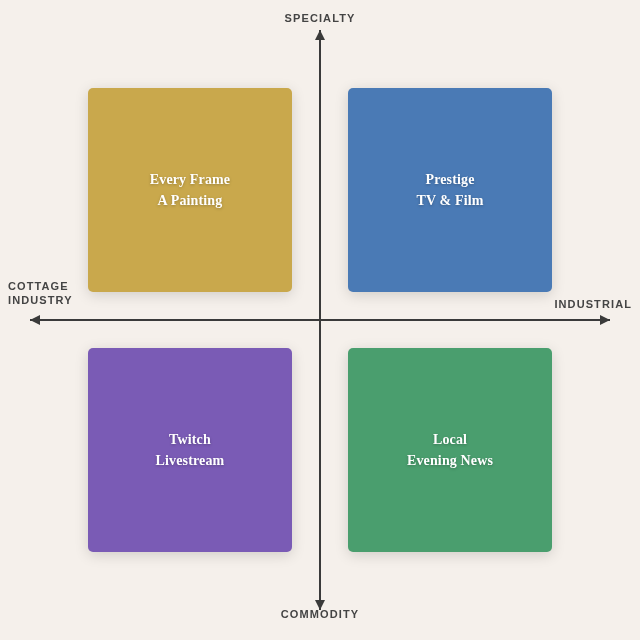
Each one of those comes with a distinct milieu, set of relationships, and economic realities (again, each of which is a great essay unto itself).
You see where I'm going with this, right? We're headed into the software Cambrian explosion. I think most of the phenomena associated with film will reproduce themselves in software because so many of the dynamics are similar. But there are also ways that software is distinct that could lead to things getting weird. Here's the biggest difference I find myself thinking about a lot:
Have you seen the move Be Kind Rewind? If not, you should, but the premise revolves around 2 video store clerks remaking home versions of blockbusters movies. You can imagine - it has a distinct appeal, but it's very much not the same thing. You can pirate a movie, but you can't duplicate and modify it. Not so with software. In fact, the ability to adopt and adapt code is at the heart of software development.
Industrial-scale, speciality software is not deeply threatened by this; I can't, for example, recreate and adapt Final Cut Pro. What people have been calling the SaaSpocalypse, though, might be a story about the risks for industrial scale, commodity grade software: there are lots of ways that a lot of SaaS has been feeding on its huge profit margins while being antagonistic to its own customers because of a perceived sense of lock-in that might just be deteriorating.
Commodity-grade cottage scale software is likely to become the terrain of hobbyists or the software will become a piece of a more complex business model (kind of how streaming revenue is not the primary revenue source for many musicians) because that software will serve a distinct niche, and people will be able to make their own version of whatever it is that commodity grade software is doing for them if they feel like the value exchange has become too unfavorable. Beyond that, all it takes is one person to make a similar tool and make it free to distribute and modify to shoot a big hole in a commodity-grade piece of software.
I'm curious about what happens to cottage industry specialty software. It could be headed into a golden age where many people only want to pay for well made, opinionated software that does something particularly novel or interesting. Even in that golden age construct, that's going to be a competitive realm that will require deep skilling and expertise (though probably not the same exact expertise as right now). But it could also be moving into a world where the idea of paying for software becomes dubious, regardless of quality level. I'm an optimist here: I think there will always be people who recognize and value quality. I also think that people who enjoy making things for others to use will find new routes to viability.
But, like I said, I think it might all get weird.
Member discussion