
Not my favorite month

An invitation
Before we jump in, I have 2 online pop-up events happening in August that I wanted to invite you to join. They're both free and both focused on how to explore divergent possibilities in the world of education.
- Steal Like an Educator (August 17) - the best ideas for how people develop don't always come from the world of formal education. We'll look for inspiration in some other fields and apply it to education.

- Book & Build Club (August 24) - unlike a typical book club, not everyone needs to read the same book for this one (or even not read the book and pretend that you did), and instead of just discussion we're going to actually build prototypes based on ideas in the books we've read.

(Was this just my excuse to make myself read all of Teaching to Transgress by bell hooks? It wasn't not that...)
How the train went off the tracks
I stood staring up at the big departures board in the middle of Utrecht's main train station, confronted with a decision: where was I going today? When I chose this particular day to kick off this little experiment, I didn't know it would be a day when all I really wanted was escape.
The experiment itself wasn't anything too fanciful. Back in June, the Dutch rail service NS had announced a summer special: unlimited off-peak train service for €49 per month. I - a person who both loves a deal and loves riding a train - jumped on this deal with haste and ferocity that was borderline unbecoming and had received more than my €49 worth of value in the first 3 days of activating my subscripton. Those 3 days also happened to coincide with the worst heatwave to hit Europe in decades, and I couldn't help but notice that one of the few places that was consistently air conditioned was the inside of the NS train cars. I thought to myself, "this wouldn't be such a bad place to work." And so the experiment was born: once a week, I would use the NS train as my mobile office. I would board sometime after 10am (when peak transit hours end), work while riding somewhere and stopping as often as I liked along the way up until the hour of 4pm (when peak transit hours resumed), then I would find a library to continue working in until 7pm (when peak transit hours once again ended), and then I would find my way home. Where would I go? It didn't really matter. Normally the train is the means to an end: there's a destination I need to reach, and the train is the way to get there. Not so for my mobile studio. The train would be the end unto itself simply because it could be.

So that was the plan. But we all know what John Lennon said: Life is what happens when you're busy making other plans. On the first day that the mobile studio experiment was supposed to kick off, Life happened. It presented itself in the unassuming form of a text message that I found waiting for me when I woke up: "Still up? Have news that’s better to share over the phone."
So began a short chain of events that soon ended with me finding out that my dear friend and colleague Wyman Khuu had died unexpectedly.
I still found my way to the train station somehow and onto a train headed toward Delft, but the mobile studio was a laughable notion at that point; I was wandering in a daze and could barely focus on anything for more than a few minutes.
Nothing inside of me - not my brain, not my heart - was able to accept the idea that Wyman was dead, because Wyman was one of the most overwhelmingly alive people I've ever known. I don't want to tend toward hagiography or nostalgia, but he was someone whose days were just packed but who never seemed haggard or worn down...but nor did he seem inauthentic or naively positive. He was just very present and available to whoever was in front of him and deeply involved in whatever he was doing.
Grief is a funny thing. My therapist tells me that the traditional "5 stages" understanding has been complemented by the dual process understanding in which it's not about progressing through stages but going back and forth between feeling aspects of many stages deeply at some times and at others not feeling it at all. That not only accounts for my individual experience but also helps me to make sense of the ways that communities can grieve together, the different members of the community vacillating between the two modes and sometimes making room for others to occupy the depths of grief and being available to support.
Losing someone like Wyman leads to that kind of grief, because there are so many people who loved him dearly. And, shit, when I type that sentence my denial mechanism kicks in again. I can't believe that someone who loved so many people so well and was so deeply loved is gone. In one of my moments of gallows humor, I said to Sarah, "there are plenty of assholes who could have died tragically rather than Wyman." And I still feel that.
I could laundry list a thousand things about Wyman that were admirable, but I just want to ground in a few rich memories (if you want to see a laundry list, you can see other people's memories here)...
- the first memory that comes to mind when I remember Wyman is sitting in a room with him and about a dozen high school students talking about the social and ethical implications of AI. The conversation flowed easily, even as we got into sensitive and complicated territory, because Wyman was such an active listener and deep questioner and especially because Wyman had spent months investing in those relationships in order to build trust. He remembered every one of those young people, and he had a unique ability to draw out from them their very best - what they were interested in and what they cared about and what they hoped for in the future - because he was a trustworthy person to share those things with.
- the last memory I have of being with Wyman was hugging it out as we went our separate ways, he to catch his train home and me to head back to my hotel on the Lower East Side. We had just had dinner in an off-the-beaten path Chinatown spot that he had taken me to because he had been going there for decades. Afterwards we walked around for a while and I got to hear more of his New York story. He had spent his early years living in Chinatown before moving out to Queens, so the physical environment was full of stories and history and minutiae. "My uncle used to work there" he'd say, or "you want the best (fill in blank of any Chinese dish) in New York? It's here", or "my dad actually owns that building." It was late, but it was almost the summer solstice so the sun wasn't down yet. I watched him literally walk off into the sunset.
- and one of my wiser friends told me that one of the ways that he has turned grief into remembrance when he has faced these things is to choose a meaningful aspect of that person, think about a practice that reminds you of that part of who they were, and when you participate in that practice let yourself pause for a moment and remember and be grateful for them. And Wyman was one of the first people I messaged when the Knicks won the Finals...so I know that when I watch the Knicks, I'll always remember him. By the time the new season starts, I hope I can be in the place that I will inevitably need to arrive where I can say, "I was so abundantly privileged and blessed to know him." For now, though, I'm still just sad.
At this point, there has been more than one train ride where the grief has crept up on me and absolutely overwhelmed me, and it turns out that one of the underrated features of the NS train's seating arrangement is that you can sit unobserved in a lot of seats and weep quietly without anyone noticing. So I'm still getting my €49 worth.
Thanks for bearing with me...now let's get into:
My new favorite analogy
I was pretty excited to pick up Magnifica Humanitas, and not just because the Pope is an honorary Nova Knick.
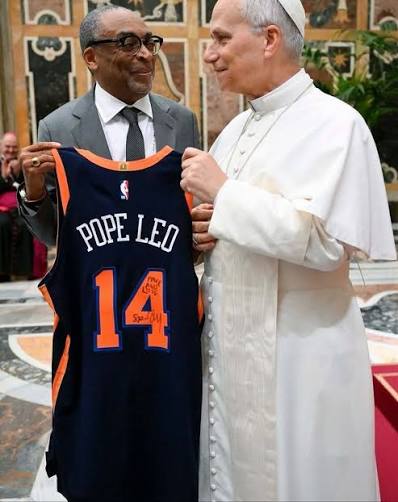
I'm not a Catholic, but a lot of my favorite writers about the existential challenges of modernity are, and I'm ready to put Magnifica Humanitas up there with The Technological Society and The Moviegoer as one of the great works in reckoning with the relationship of humanity and technology.
Credit to Pope Leo, he is an accessible writer and he begins the encyclical by contrasting two stories from the Hebrew Bible that are about humanity & technology. The first is among the most common classical reference points, to the point that it is a known term beyond any religious context: the Tower of Babel. But it's the second story that he sets as the counterpoint to Babel that I'm quite taken with, in part because I hadn't previously thought about it as a story of technology: Nehemiah rebuilding the wall of Jerusalem.
In Leo's rhetoric, Babel is a story of the desire for technology as a means of dominating the natural world and of humanity trying to elevate itself to the level of deity with predictable negative consequences. That's old hat. In contrasting the story of Nehemiah, he introduces a technological paradigm that I would like to see become more of a widespread reference:
The technology to rebuild the wall is grounded in the needs and relationships of the community that use it, and the wall is not rebuilt because of the technology; it is rebuilt because of the sense of shared communal responsibility and obligation to each other. The reason that it isn't traditionally considered a technology story is because the technological feat isn't front & center, the people & the culture are. As Leo would have it, the technology is only used in service of the values of providing for the common good, advancing the cause of justice. It is used by a community acting in solidarity and allowing decisions to be made at the lowest level of authority possible.
These form a few of the tentpoles of Leo's framework for how we should think about our relationship with technology, and in that spirit I wanted to share a few links that I think are in conversation with Leo and with Magnifica Humanitas:
- As I read Magnifica, I found myself connecting it more and more with the Solarpunk Manifesto. It is a little jarring and dissonant to consider the Catholic Church and the anarchy of punk in the same breath, but we've been living in the weirdest timeline for a while.
- This latest season of The Dissect about Daft Punk spends a good amount of time getting into how the group uses its work to explore the relationship of human & robot as a means of getting at the essence of what it is to be human.
- Not entirely in opposition to Magnifica, but far more on the AI doomer end of the spectrum is AI as Christian Heresy. I think this one is a little messier, as LM Sacasas - whose newsletter the Convivial Society is wonderful - is not as rigorous as I would like in disentangling generative AI as a technology from the companies advancing AI in the service of technological inevitability.
Some light housekeeping...
If you're reading this as an email, then you will not have noticed that I've done a pretty thorough visual revamp of the website. The old version was about 5 years old, and I was getting to the point where I was starting to hate looking at it and felt increasingly dismayed with the readability of my font choice...and I just wanted it all to feel a bit more playful. So far, I haven't done a full on revamp of the organization of the site...but it's in the backlog.
Have a look!
Member discussion