
Nerd Notes: January
A lot of big news in the world of Pokemon since the last edition of Nerd Notes…all of it pretty nerdy. But also, over the holiday break my brain started going off on some ideas that have been sitting there stewing for a while…so I want to tell you about my big themes for this year and one new project that I’m working on.
This year’s themes
- Make radical commitments - I think a lot about systems; I work a lot on designing systems. Sometimes that thinking and work is about understanding and making marginal refinements to existing systems. In 2025, I want to really build the muscle of thinking and acting more radically as well as owning the fact that this is often my natural inclination. This is very likely to play out even more in the ways that I articulate a lot of the educational design work that I do; I increasingly care about the societal and civic vision that education contributes to, and I think both the vision and the means of enacting it can be bolder. I also think I have a client lineup for my paid work this year that has a big appetite for this, which is fun as hell.
- Be deliberate about playfulness - more than just playing a lot, this is about taking seriously the importance of play as a means of exploration and connection. I have a strong feeling that this intersects with radical commitments; counterintuitively, I think play is one of the primary means by which we can engage with big, thorny real world challenges.
- Find lots of reasons to celebrate, and celebrate as an antidote to despair - I want to develop a deeper appreciation of sparkling wine this year, and part of that is finding the cavas and proseccos that can be imbibed with no need for an occasion, but I want a big part of that to also be finding more reasons to justify popping a nice to very nice bottle and having a toast with friends. These moments often pass us by and go unremarked on; this year I want to make a point of slowing down and saying, “Hey, this is an occasion. Let’s celebrate.”
Pokemon update 1: The Elo system
For those of you that follow competitive chess, Elo is a well known concept (that I, up until today, thought was an acronym. It’s not. It’s the last name of the guy who came up with the system): it’s an individual rating that goes up or down based on both the outcome of a match and the rating of the opponent, the idea being that if you beat someone who is theoretically better than you then you should rise and they should fall.
For online play, Pokemon uses TCG Live, which I’ll just call Live. Live has always had a competitive ladder, however the number of points for a win didn’t change based on the quality of the opponent but rather on the level of the ladder you were on. With the latest update, Pokemon has introduced an Elo system for players who reach the top level of the ladder. In effect, it creates a whole separate division at the top where players at that level only face off against each other, and the players’ ratings change based on the rating of their opponent.
And, indeed, the Trudeaus did grind out matches over the holiday break in order to reach the Elo division and are there now.
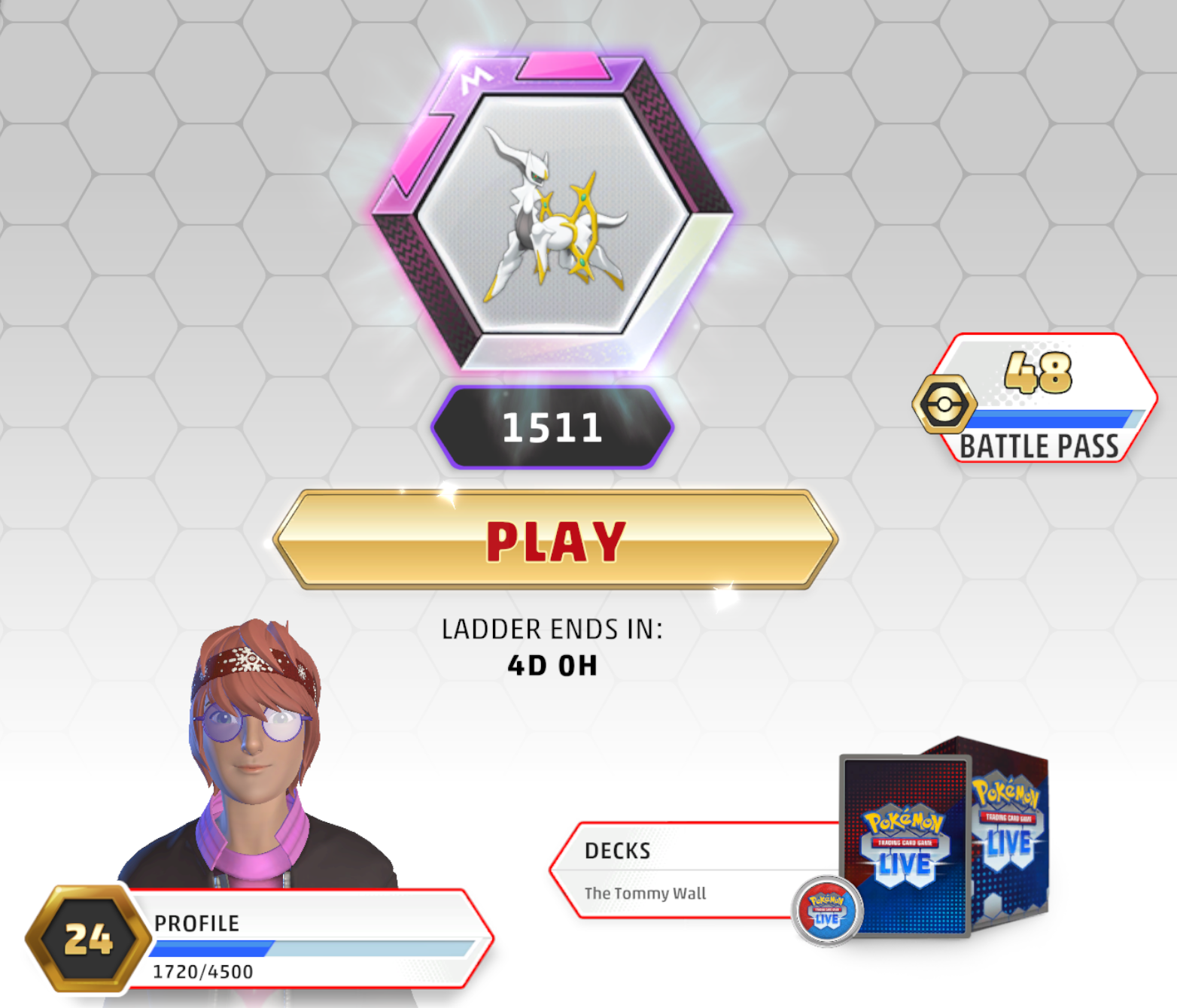
Within the broader Pokemon community, people are now clamoring for a leaderboard to see who the top players in the world are by Elo, and I think I support the idea while at the same time not actually caring that much about Elo myself. I kind of wonder if the Elo system disincentivizes creativity and innovation in deck building because it’s so hard to exhaustively & rigorously test ideas using the non-ranked version of the game (which also exists as a different play mode). Then again, I also have to remind myself that this is really just a game after all…
Pokemon update 2: Rotation
Since the last edition, the next card rotation has been officially announced. The Stockholm tournament in March will be the last one in Europe with the F regulation mark cards.
By way of background, Pokemon changes the cards that are legal to play in the competitive format. Three or four times a year new cards are added in, and once a year some older cards are rotated out. If you’ve ever thought that you might just pick up that Charizard deck that you built when you were 11 and get back in the game, this is bad news. If you want a constantly evolving meta that creates new challenges and possibilities, this is good news.
This rotation is a very big one: with this rotation, all of the special Pokemon V and Pokemon V Star cards will go out of play. Not only does this mean that some entire deck types are gone, but also some critical pieces of nearly every current meta deck will need to be replaced. The current “best deck in format” is the Regiodrago V Star deck, and as the name suggests it is entirely driven by a V Star card. It’s gone. The Lugia V Star deck - another very successful deck - it’s gone. Additionally, this rotation removes all of the Radiant-type cards. These were basic Pokemon with special abilities that players could only have 1 of in their whole deck. Every card that sends cards to the Lost Zone - and therefore all of the Lost Box meta decks - also gone.
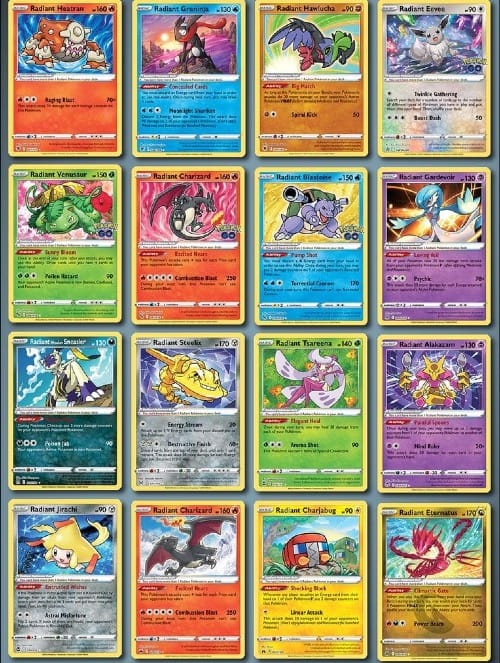
And it’s not just V, V Star, and Radiant that are going away…there are just a lot of cards that have been pretty standard staples for consistency that are going out of format. It’s going to be a big upheaval.
In the short term, it’s going to slow the game down significantly. Most of the cards that provided a draw engine that lets players find more resources to use by drawing cards are going away. Maybe future releases of new cards will counter that, but for at least the first couple tournaments it looks like we’ll be playing in a format that rewards slow burning decks like Dragapult ex and Charizard ex.
A tangent on rotation
I made a suggestion on the /pkmntcg subreddit that I should try and build a deck for Stockholm in which all 60 cards will rotate and asked whether people thought I could make something consistent enough to actually be competitive. I was - to put it mildly - surprised by some of the reactions.

To be totally candid, I felt like I was seeing a kind of groupthink on the sub that I don’t see IRL; there were just so many people whose response was “nope, no way this could ever work”…which is interesting to me, because I think it’s very possible that they are correct but the lack of engagement with the thought experiment was really surprising. The Lugia V Star deck in particular already has SO MUCH of its standard 60 cards that are going to rotate that it feels like there is actually a possible build of it that could be somewhat competitive - it won’t win the event, but could it go off for a couple wins and a couple draws? Probably.
That said, I’m probably not going to actually do this. The best candidates so far just aren’t fun enough to justify playing them for a whole regional tournament (a legitimate point that some people did make in the thread). Someone on the sub suggested to maybe do it to a local event before rotation, and I think that’s probably right.
Looking to Birmingham
This weekend, the 3 Trudeaus are all playing the same deck for the Birmingham regional championship; Tommy cooked it up with a couple friends on Discord and calls it The Wall. They played it in Stuttgart to 19th place and convinced us that it was a good pick and that it would be fun to all test and play the same deck for at least one tournament, so I went along with it. In truth, it’s probably a great pick for Nate playing in Juniors, a very good pick for Tommy playing in Seniors, and a pretty mid pick for me playing in Masters. The deck’s biggest weakness comes against the Gardevoir ex deck, which is extremely unpopular at the Junior level because it’s complex to pilot, but it’s one of the most common decks at the Master level. Fortunately, I can’t really do much worse than I’ve been doing, and if I’m running into a bunch of Gardevoirs that probably means I’m getting some decent results. And it’s a fun enough deck to play, so I won’t mind leaving Tsareena behind for one tournament.
You can get a feel for the deck in this video play through. The main thing to know is that it is built around 4 different Pokemon, each of which can’t be damaged by attacks from specific types of Pokemon:
- The Cornerstone Mask Ogerpon ex can't be attacked by any Pokemon that has an ability.
- The Mimikyu can't be attacked by any V or ex Pokemon.
- The Noivern ex has an attack that makes it immune to all basic (non-evolved) Pokemon.
- The Milotic ex can't be attacked by Tera type Pokemon.
The strategy comes down to recognizing which Pokemon to develop based on your opponent’s intended strategy. There are quite a few decks where it is an automatic victory, including the Charizard ex deck which is one of the top 3 most popular in the format.
A sneak preview: Oldies But Goodies
From time to time, I figure I’ll use this space to share a preview of one of the many projects running around in my head that I’m actually toying with. By the time the next Nerd Notes reaches your inbox, I think I’ll have done the first playtest of an in person game I’ve been dreaming up for the last few months tentatively called Oldies But Goodies.
Here’s the basic pitch: it’s a partner-based mash up of scavenger hunt and storytelling that happens at a used bookstore. People show up, get matched with a partner, and get a 50 card deck from which they are dealt 5 cards. Each of the cards has a kind of book they need to find and a prompt of a personal story they need to tell behind why they chose that book. They’re then sent off for 45 minutes with their partner, and they can come back for new cards when they’ve completed their first 5. Every card has a point value on it, and there’s a bonus for every book your time finds that you choose to buy at the end of the time period. At the end of the 45 minutes, participants reconvene in a cafe (or bar depending on time of day) to have a drink and compete to win the bonus point story cards for who has the best story from their book search.
The point of the game is to form a deep connection with another person through acts of serendipity. I have a preference for used book stores because I think they’re even better than new book stores for the creation of serendipity (though both are better than online shopping) for the simple reason that used book stores often stock a much greater number of titles per square foot - most of their purchases aren’t bulk purchases, and their inventory extends beyond what is currently in print. You also never really know what they will or won’t have, so the novely factor is much higher.
Every number in the description above is very much a placeholder - that’s probably what I’ll try first, but all still TBD. But I’ll have to make enough decision to get a first testable version, because I’m going to playtest it while I’m in Toronto the first weekend of February.
If it goes well enough - as with all things like this, what I’m looking for in the first test isn’t whether it’s flawless but whether there’s a spark of magic to it - then I’ll keep iterating and probably run playtests alongside a lot of my work travel this year.
Member discussion